

Sustainability Meets Innovation
UN Global Chemical Leasing Award 2025
As part of our living commitment to sustainability, innovation and value-chain cooperation Fecc is a long-standing supporter of the United Nations’ Global Chemical Leasing Award scheme.
On 13th March 2025, the Award-giving ceremony for the 2024 edition took place in Vienna, Austria, and Fecc was very honored to be invited to actively contribute to it.
Under the auspices of UNIDO, the Austrian Bundesministerium für Klimaschutz, Umwelt, Energie, Mobilität, Innovation & Technologie, and the Center for Green Chemistry & Green Engineering at Yale, the Award winners in 5 different categories received their well-deserved recognitions for developing outstanding performance-based business models, coupling sustainability with innovation.
Sustainability Meets Innovation was also the headline for 3 practical use cases, presented by top managers from Fecc member companies Arkema, Brenntag and SAFECHEM.
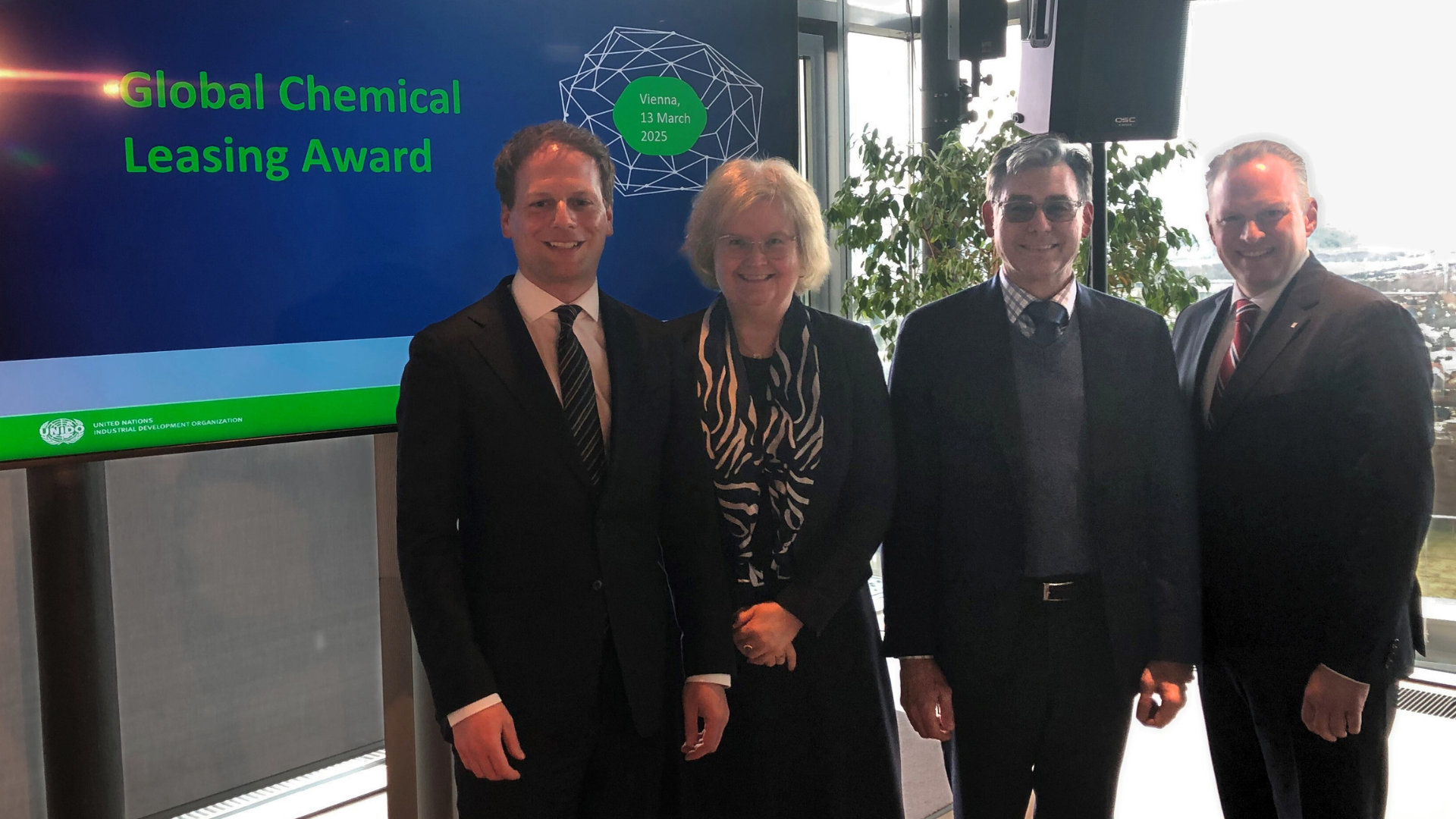
In their examples, Richard Jenkins, Benjamin Deister, and Steffen Saecker showcased:
- how proactive value chain cooperation can lead to brandnew sustainable processes and products,
- how proactive governmental incentive schemes can lead to significant and measurable environmental improvements
- what (more) is needed to upscale sustainability and innovation to provide the sustainable solutions the world needs.
These aspects, the high potential of green chemistry and how to bridge the gap between universities and industry to further accelerate innovations along the value chain were just some of the many diverse topics discussed in a multistakeholder format over the day, which brought together regulators, industry, and academia.
Watch related presentations in the following videos.
As part of our living commitment to sustainability, innovation and value-chain cooperation Fecc is a long-standing supporter of the United Nations’ Global Chemical Leasing Award scheme.
On 13th March 2025, the Award-giving ceremony for the 2024 edition took place in Vienna, Austria, and Fecc was very honored to be invited to actively contribute to it.
Under the auspices of UNIDO, the Austrian Bundesministerium für Klimaschutz, Umwelt, Energie, Mobilität, Innovation & Technologie, and the Center for Green Chemistry & Green Engineering at Yale, the Award winners in 5 different categories received their well-deserved recognitions for developing outstanding performance-based business models, coupling sustainability with innovation.
Sustainability Meets Innovation was also the headline for 3 practical use cases, presented by top managers from Fecc member companies Arkema, Brenntag and SAFECHEM.
In their examples, Richard Jenkins, Benjamin Deister, and Steffen Saecker showcased:
- how proactive value chain cooperation can lead to brandnew sustainable processes and products,
- how proactive governmental incentive schemes can lead to significant and measurable environmental improvements
- what (more) is needed to upscale sustainability and innovation to provide the sustainable solutions the world needs.
These aspects, the high potential of green chemistry and how to bridge the gap between universities and industry to further accelerate innovations along the value chain were just some of the many diverse topics discussed in a multistakeholder format over the day, which brought together regulators, industry, and academia.
Watch related presentations in the following videos.
Intriduction by Dorothee Arns, Director General, Fecc
“Chemical Waste as a Resource – An Eco-Innovation Project” by Benjamin Deister, Regional President, Brenntag BES EMEA Central
“Powder Coatings with Recycled PET Bottles” by Richard Jenkins, SVP Coating Solutions, Arkema
“Industry 4.0: Using AI to Measure Sustainability Performance” by Steffen Saecker, Business Director, SAFECHEM Europe
Danish GEAR project
The starting point of the project is to explore the opportunities in using high-quality second-hand chemicals used as industrial processing aid substances. This results in higher utilization of chemicals for more industries (Pharmaceuticals, Food and feed and the transport industry, chemical-technical industry), better CO2 gains and the potential for a new business model with a more sustainable approach in the chemical distribution supply chain.
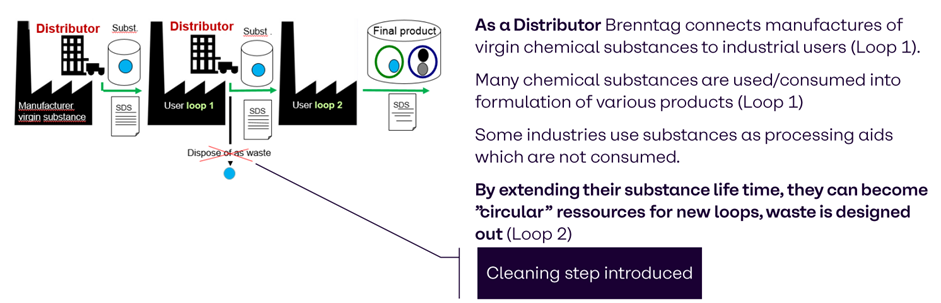
Initial results show that in Denmark alone, which is 1.30% of the EU-27 population, 36000 tonnes used in processing aids is estimated for potential saving from waste.
Preliminary technical results show that:
- Chemical recovery is part of the environmental policy agenda for the circular economy as a practical and tangible way for companies to work with sustainable production.
- There are specific technical barriers that need to be addressed. There are impurities in the process chemicals used, for example pharmaceutical intermediates, where players have an interest in that the impurities do not technically impede recycling but also have no impact on humans or the environment.
- Purification is a key consideration in circular chemistry, to provide security for both primary and downstream businesses and to manage every single risk.
- It is important that existing purification methods are further developed so that they are optimally environmentally and energy-wise, while the obtained purification result simultaneously meets the requirements of a downstream user.
- There is interest in – and the capacity of – distributors to solve the logistical problems, contribute to the design of quality requirements, in addition to identifying users of circular chemicals.
The motivation factors of the project are economy, CO2 footprint, ambition about more re-use, resource minimization, waste prevention, CO2 tax (DK 2025: 350 dkk/CO2 ton. 2030: 750dkk/CO2 ton), sustainability profile, branding, explore joint venture.